Indonesian RBD Palm Olein vs Crude Palm Oil
Compare RBD Palm Olein vs Crude Palm Oil from Indonesia so buyers can match grade, MOQ, packing, Incoterm, and documents before quoting.
By Rina KartikaHead of Vegetable Oil TradingEight years structuring RSPO and ISCC palm oil programmes for refiners, food manufacturers, and biodiesel blenders across Asia and Europe.
RBD palm olein and crude palm oil are not interchangeable buying descriptions. One is a refined liquid fraction used when the buyer needs low FFA, light colour, and a defined cloud point. The other is a crude feedstock bought mainly for refining or further processing.
We write this as the export desk at Indonesia Palm. This guide is for importers, refiners, food manufacturers, oleochemical buyers, and procurement teams comparing Indonesian RBD palm olein against CPO before they issue a purchase inquiry.
What is the difference between Indonesian RBD palm olein and CPO?
RBD palm olein is a refined, bleached, deodorised liquid palm fraction. CPO is crude palm oil, so the buyer normally treats it as refinery or process feedstock rather than as a finished edible oil.
For our Crude Palm Oil (CPO), the export specification is FFA ≤ 5.0% as palmitic, moisture and impurities ≤ 0.1%, iodine value 50 to 55, DOBI ≥ 2.5, MOQ 3,000 MT by vessel lot, bulk vessel or shore tank packing, 2 to 3 weeks lead time from contract, ISPO, Halal BPJPH, and ISO 22000 certification, FOB, CFR, or CIF Incoterms, and HS code 1511.10.

Featured product
Crude Palm Oil (CPO)
Bulk vessel crude palm oil from Sumatra refineries with published FFA, DOBI, and moisture limits for refinery and oleochemical feed.
ISPO · Halal (BPJPH) · ISO 22000
View specificationsFor our RBD Palm Olein IV56 RSPO Mass Balance, the export specification is FFA ≤ 0.1%, iodine value 54 to 56, cloud point ≤ 10°C, colour ≤ 3R Lovibond 5¼", MOQ 500 MT by flexitank or 3,000 MT by vessel, flexitank 20 ft or bulk vessel packing, 2 to 3 weeks lead time from contract, RSPO Mass Balance, ISO 22000, and Halal BPJPH certification, FOB, CFR, or CIF Incoterms, and HS code 1511.90.
The practical difference starts with processing status. A buyer asking for CPO should be ready to refine, fractionate, or convert the oil. A buyer asking for RBD olein is usually trying to receive a refined oil with a defined fluidity profile and finished-oil quality limits.
FFA is one of the clearest dividing lines. CPO allows a higher FFA limit because it is crude. RBD olein has a much lower FFA limit because refining has already removed most free fatty acids.

DOBI matters on CPO because it helps buyers judge crude oil quality for refining. Cloud point matters on RBD olein because the buyer needs to know how the oil behaves at lower storage or distribution temperatures.
If your internal specification names IV56 olein, start with the RBD olein route rather than asking for generic “palm oil.” If your plant has refining capacity and wants crude intake, CPO is the grade to discuss first.
Which grade fits food, refining, oleochemical, or fuel use?
Choose RBD palm olein when the buyer needs a refined liquid palm fraction with low FFA and a stated cloud point. Choose CPO when the buyer wants crude feedstock for refining or further industrial conversion.
Food buyers usually compare RBD palm olein claims before they compare crude oil. If the end customer accepts RSPO Mass Balance, IV56 olein can move in flexitanks from 500 MT. If the brand owner requires physically separated certified material, the route changes to RBD Palm Olein RSPO Segregated, which carries a 500 MT flexitank MOQ and a longer lead time of 3 to 4 weeks from contract.
Refiners often look at CPO because they control the refining step themselves. In that case, the buying discussion should focus on FFA, moisture and impurities, iodine value, DOBI, vessel lot size, and discharge planning. A refinery that can receive bulk vessel parcels may prefer this route over buying refined oil, provided the economics and capacity fit.
Oleochemical buyers may use CPO when their process can handle crude characteristics and when downstream conversion, not finished edible quality, is the target. If the process needs a hard fraction instead, RBD stearin becomes a separate product decision. We list these options in our oleochemical feedstock palm oil range so buyers can compare feedstock routes before quoting.
Fuel and renewable diesel buyers should not assume standard food olein or CPO will satisfy a certified fuel programme. If ISCC EU scope is required, the correct inquiry should name that certification at the start. Our ISCC EU olein product is separate from the Mass Balance and Segregated food-grade routes.
What is the MOQ and price context for RBD palm olein vs CPO?
Our MOQ is 500 MT for RBD Palm Olein IV56 RSPO Mass Balance by flexitank or 3,000 MT by vessel, while our CPO MOQ is 3,000 MT by vessel. Price depends on grade, certification claim, packing, Incoterm, volume, shipment timing, season, freight, and Indonesia export costs at the time of contract.
A 500 MT flexitank inquiry suits buyers that want RBD olein without taking a full vessel parcel. It also gives the importer container-level shipment planning. A 3,000 MT vessel lot suits larger buyers that can receive bulk cargo and want the freight structure of a vessel shipment.
CPO is different because our route is vessel lot supply. A buyer asking for one or two containers of CPO is not matching our published CPO packing route. In that case, the buyer should either revise the quantity to vessel scale or consider whether a refined oil in flexitanks fits the application better.
We do not publish spot palm oil prices in sourcing articles because they become stale quickly. Physical offers are commonly built from traded palm oil benchmarks such as Bursa Malaysia Derivatives FCPO, then adjusted for Indonesian origin, refining status, certification claim, packing route, freight, payment terms, and shipment month.
Indonesia export cost also affects the offer. Indonesia’s Ministry of Trade publishes the reference price used in export duty administration, and Indonesia’s Ministry of Finance publishes the export duty and palm oil levy rules. The number that matters is the rule and reference price in force for the contract and shipment period, not an old example copied into a buying note.
For a current quotation, send us the grade, volume, packing route, destination port, Incoterm, shipment month, and certification requirement through our contact page. If you are comparing RBD olein against CPO internally, include the plant application so we can quote the route that fits the receiving operation.
How should a buyer specify quality before contract?
A buyer should specify the grade by its quality limits, not by a short trade name alone. “Palm oil CIF” is too broad because RBD olein and CPO differ in FFA, quality tests, HS code, packing, and receiving equipment.
For RBD palm olein, the purchase inquiry should state the iodine value target, cloud point, colour limit, FFA limit, certification claim, packing format, and whether flexitank or vessel delivery is required. If the buyer needs RSPO Mass Balance, the inquiry should say so. If the buyer needs Segregated, it should not be left as “RSPO” because the claim model changes the supply route.
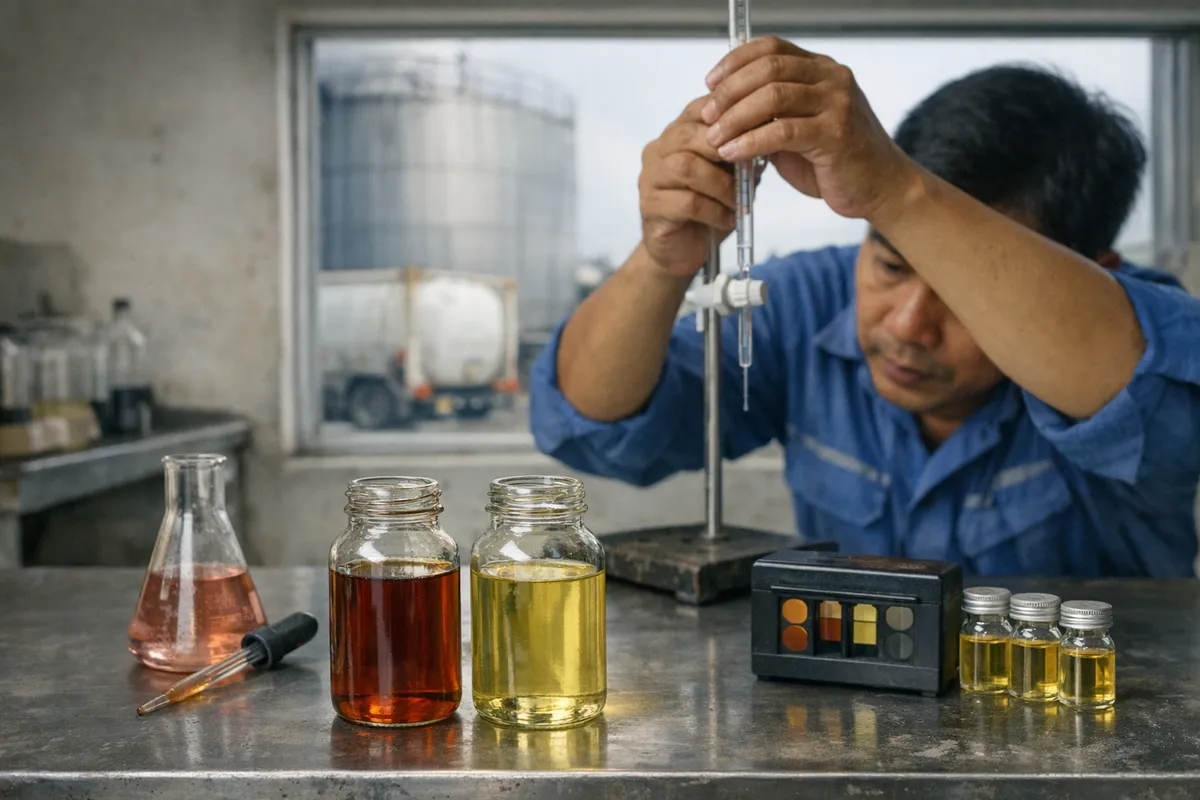
For CPO, the inquiry should focus on crude oil intake tests. FFA, moisture and impurities, iodine value, and DOBI are the commercial quality points to align before the contract is signed. A refinery should also confirm whether its shore tank, jetty, or discharge plan can handle a 3,000 MT vessel parcel.
The receiving laboratory method should be addressed early when the buyer has strict internal intake rules. If a factory uses a tighter limit than the sales specification, that tighter requirement belongs in the negotiation before contract. It should not appear for the first time after cargo has arrived.
The specification should also match the document wording. If the contract says RBD palm olein IV56, the invoice, bill of lading description, certificate of analysis, and certification documents should not drift into a generic vegetable oil description unless the buyer’s bank and customs broker have approved that wording.
What documents and Incoterms should be fixed before shipment?
Fix the document set, HS code, Incoterm, consignee details, and certification claim before loading. Document corrections after vessel sailing or container dispatch can delay bank presentation and customs clearance.
For both CPO and RBD olein, the normal shipment file should include the commercial invoice, bill of lading, certificate of analysis, and any certificate required by contract. If Halal or sustainability documents are required, the product and claim model should match the contract. A Mass Balance claim is not the same as a Segregated claim.
The HS code also differs. Our CPO is supplied under HS code 1511.10, while our RBD palm olein routes are supplied under HS code 1511.90. The importer’s customs broker remains responsible for the destination declaration, but the buyer should check that the product description and HS code are consistent before documents are issued.
Incoterm choice changes the cost build-up. Under FOB, the buyer controls the main freight arrangement. Under CFR, we arrange ocean freight to the named destination port, while insurance remains with the buyer. Under CIF, we arrange freight and marine insurance to the named destination port. Destination import clearance, duties, taxes, port charges after arrival, and inland delivery remain buyer-side items unless a contract states otherwise.
Buyers preparing their first Indonesian palm oil shipment can use our article on how to import Indonesian palm oil to structure the document checklist before requesting final price.
How should the final grade choice be made?
Choose RBD palm olein when the buyer needs refined quality, low FFA, a defined cloud point, and container or vessel options. Choose CPO when the buyer has the capacity to receive vessel-lot crude oil and wants feedstock for refining or industrial processing.
The decision should be made in this order: application first, then quality specification, then certification claim, then packing route, then Incoterm. Price comparison comes after those points are fixed. A cheaper headline offer can become the wrong cargo if it requires the wrong receiving equipment or cannot support the customer’s claim.
For food programmes, start with RBD olein and decide whether Mass Balance or Segregated is required. For refinery intake, start with CPO and check crude quality limits against plant capability. For biodiesel or renewable fuel programmes, state the certification requirement at the first inquiry because the product route is different.
A clear inquiry saves time on both desks. Send the intended application, destination port, target shipment month, quantity, Incoterm, and required documents via our contact page, and we will respond against the Indonesian grade route that fits the request.